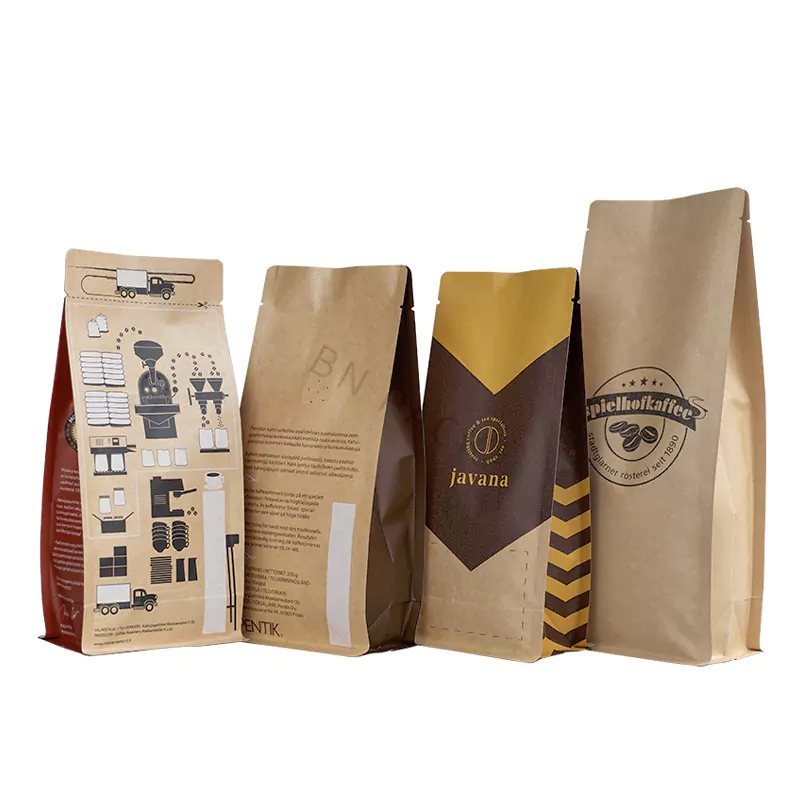
The most common wholesale coffee packaging styles are stand-up pouches, flat-bottom bags, side-gusset bags, quad-seal bags, and three-side-seal pouches. Retail packs usually hold 100 g, 250 g, 340 g, 500 g, or 1 kg, while foodservice formats often run from 1 kg upward. Fresh roasted coffee can retain roughly 4–16 mg of CO₂ per gram depending on roast conditions, so many whole-bean bags use a one-way valve. Flat-bottom and stand-up formats dominate premium retail use because they combine printable surface area, zipper options, shelf stability, and automated filling compatibility.
Stand-up pouches are widely used for 100–500 g retail packs because a bottom gusset lets a thin empty pouch expand into a stable package after filling. A 250 g pouch commonly needs more internal volume for dark roast than light roast because roasting can expand bean volume by roughly 40–60% while roast mass loss may reach about 20%. That difference explains why suppliers normally ask for an actual fill test instead of relying only on the stated net weight, and the same volume issue leads naturally to flat-bottom formats.
Flat-bottom bags use a rectangular base plus front, back, and two side panels, giving brands five printable faces when the bottom is included. For 250 g, 340 g, 500 g, and 1 kg specialty coffee, the geometry provides a broad front face without requiring a very wide pouch, while the side panels can carry origin, altitude, processing method, tasting notes, roast date, and brewing instructions. A 2022 study on opened coffee packages also found that closure method affected aroma retention, supporting the use of resealable systems when consumers keep a bag for several days. That closure issue becomes more noticeable in traditional side-gusset bags.
Side-gusset bags expand along two vertical folds instead of a bottom gusset. Empty bags stack flat, filled bags use shelf depth efficiently, and 500 g or 1 kg packs can be produced without the broader base construction of many flat-bottom designs. The format has been used for coffee for decades, often with a top heat seal, adhesive strip, tin tie, or separate reclosure. Because roasted coffee can release CO₂ for several weeks after roasting, a side-gusset bag intended for fresh beans still needs enough seal strength and suitable venting rather than relying on its shape alone. Greater package stiffness leads buyers toward quad-seal construction.
Quad-seal bags add four vertical seals around the corners, so a filled 500 g or 1 kg pack holds a more rectangular profile than a conventional side-gusset bag. The extra seams use slightly more sealing area, but they also help the package stay upright during shipping, shelf stacking, and handling.
Quad-seal construction is useful when the pack is relatively tall or heavy because the side panels are defined by seals rather than folds alone. It also gives printers separate front, rear, left, and right graphic areas. For wholesale work, the buyer should compare finished dimensions rather than nominal capacity: two bags both sold as “1 kg” can differ by several centimeters in width, gusset depth, or height depending on coffee density and desired headspace. Once pack size falls below normal retail weights, simpler flat pouches often make more sense.
Three-side-seal pouches are common for samples, single portions, tasting kits, hotel coffee, and promotional packs. They are sealed on three sides before filling and closed along the remaining edge afterward, which removes the gusset-forming steps required by stand-up formats. A roaster selling 50 g samples can therefore store thousands of empty pouches in much less space than the same number of preformed box-style bags. Small packs also have a higher packaging-to-coffee ratio, so material thickness and printing cost deserve more attention as unit weight falls below 100 g.
| Bag style | Common retail use | Typical closure | Main practical benefit |
|---|---|---|---|
| Stand-up pouch | 100–500 g | Zipper + heat seal | Compact, stable retail format |
| Flat-bottom bag | 250 g–1 kg | Zipper + heat seal | Five printable surfaces |
| Side-gusset bag | 250 g–1 kg+ | Heat seal, tie, tape | Efficient rectangular fill |
| Quad-seal bag | 500 g–1 kg+ | Heat seal or zipper | Better shape retention |
| Three-side-seal pouch | 10–100 g | Heat seal | Low material use for samples |
Bag shape alone does not preserve coffee. Roasting temperatures commonly exceed 200°C, and CO₂ accounts for more than 80% of gases formed during roasting. One published study measured about 6.3–6.7 mg/g of residual CO₂ in light roasted beans, around 11.0–11.5 mg/g in medium roast, and roughly 15.4–15.6 mg/g in dark roast samples. A package filled soon after roasting therefore needs a way to manage gas while limiting outside oxygen, which is why valve specification follows bag-style selection.
A one-way degassing valve vents internal gas after pressure rises above the valve’s opening level while restricting reverse airflow. Older diffusion work using two coffee origins reported initial CO₂ levels of 4.0–8.6 mg/g, with an overall average of 5.7 mg/g, showing why one universal resting period does not suit every coffee. Grind size, roast temperature, roast degree, bean structure, storage temperature, and time after roasting all affect gas release, so valve placement should be checked against fill height and the final top seal.
A valve does not replace a good barrier film. It handles gas produced inside the package; the film, seals, zipper, and valve assembly together control how much oxygen and moisture can enter during storage.
Barrier performance becomes more important when the intended shelf life extends from weeks to months. Coffee loses freshness through oxidation, volatile loss, moisture movement, CO₂ release, and oil migration. A 2026 study comparing roasted Arabica in two packaging structures estimated 179 days of shelf life at 25°C for the tested monomaterial pack and 447 days for the tested multimaterial structure based on peroxide limits, a 64.35% difference under that study’s conditions. Those figures cannot be applied to every coffee, but they show why identical-looking bags may perform very differently.
Multilayer coffee bags commonly combine an outer printable film, a barrier layer, and an inner heat-seal layer. PET, PE, metallized films, EVOH-containing structures, and aluminum foil are among the materials used, depending on required oxygen and water-vapor transmission rates. Paper can be added for appearance and stiffness, but paper by itself is not normally the layer providing the high oxygen barrier expected for roasted coffee. That distinction matters when buyers compare kraft paper coffee bags with plastic-film or foil-based alternatives.
Recyclable structures need the same technical scrutiny. RecyClass guidance published in 2023 notes that inks, adhesives, barriers, zippers, and other non-PE components can represent a meaningful share of a thin flexible pack; one documented pouch example contained more than 95% PE including its PE zipper. A supplier therefore should state the full material composition rather than use “recyclable” as a stand-alone description. Material choice also affects printing, sealing temperature, stiffness, and machinery settings, which brings production method into the comparison.
Custom coffee bags are usually printed by digital, flexographic, or gravure processes. Digital printing suits shorter runs because it avoids conventional printing cylinders or plates and allows several SKUs to share a production order more easily. Flexographic and gravure processes become more economical at higher quantities, although break-even volume depends on bag size, color count, material, supplier equipment, and artwork. A brand ordering 5,000 units across five coffees has a different cost structure from a brand ordering 100,000 units of one design, so quoted unit price should include setup, printing, valves, zippers, cartons, freight, and any plate or cylinder charges.
Stock bags with pressure-sensitive labels remain useful when roast offerings change frequently. One neutral 250 g bag can serve 10 or 20 origins while individual labels carry the coffee name, lot information, roast date, or barcode. Fully printed packaging removes the separate labeling step and supports more complex graphics, but leftover printed inventory becomes harder to reuse when a coffee lot ends. A buyer ordering in 2026 should therefore compare annual consumption per SKU, not only the price of one production run, before choosing between stock and fully printed packaging.
Bag dimensions should be confirmed with the actual product before mass production. Dark-roasted whole beans, dense light-roasted beans, espresso blends, and ground coffee do not occupy the same volume at an equal 250 g weight. Roasting can increase bean volume by 40–60%, while grinding changes how particles settle and reduces empty space between whole beans. A production sample filled to the intended weight can reveal whether there is enough room above the coffee for the zipper, valve, tear notch, and final seal.
The same sample should be checked on the intended packing line. A zipper positioned 25–35 mm below the pouch top, for example, reduces the available sealing and filling space compared with a bag without reclosure. Valve location also needs clearance from the product level and top sealing jaws. Manual filling may tolerate dimensions that create trouble on an automatic line running dozens of packs per minute, so suppliers need the filling direction, seal method, planned pack speed, and acceptable dimensional tolerance before confirming production specifications.
Wholesale quotations are easier to compare when every supplier receives the same specification. Include net coffee weight, filled-bag target dimensions, film structure, total thickness, finish, zipper type, valve requirement, printing method, number of designs, quantity per design, carton packing, and delivery terms. Where shelf-life performance matters, request oxygen-transmission and water-vapor-transmission data for the complete laminate rather than only a film name. A 75% relative-humidity storage study published in 2023, for example, found greater changes in some coffee compounds than storage at 65% RH.
Physical samples should then be filled, sealed, stored, handled, and opened in the same way customers will use them. Checking 20–50 filled samples from a pre-production or early production batch can expose inconsistent seals, zipper alignment, valve position, scuffing, weak gussets, or unsuitable fill volume before tens of thousands of units are packed. For roasted coffee, the test should include several days of gas release rather than inspection immediately after sealing, because pressure can build after packing.
A roaster selling 250 g specialty beans may prefer a flat-bottom or stand-up pouch with a zipper, valve, and high-barrier laminate, while a café supplier moving 1 kg bags quickly may accept a simpler side-gusset structure. Sample programs below 100 g often fit three-side-seal pouches better, and heavier retail packs can benefit from quad-seal construction. The useful comparison is therefore based on coffee format, expected shelf time, filling equipment, yearly quantity, material structure, closure, and finished dimensions rather than bag appearance alone.