PPLNS Windows Explained With Real Hashrate Numbers
PPLNS does not pay you for the shares you submitted; it pays you for your share of pool hashrate over the last five difficulty rounds, and only after a block reaches six confirmations. At today's difficulty of 132.76 T, a 500 TH/s machine earns about 0.000224 BTC a day, so the window is what decides whether a good week shows up on your ledger in full, partially, or a fortnight later.

Key takeaways
- The PPLNS window is the last 5 difficulty rounds, not the last few hours, so your weight decays slowly after you stop mining.
- Distribution happens only after a found block reaches 6 confirmations; there is no hourly rail in PPLNS mode.
- The listed PPLNS fee is 2% on block rewards and transaction fees together, against 4% on the PPS-settled block-reward component in PPS+.
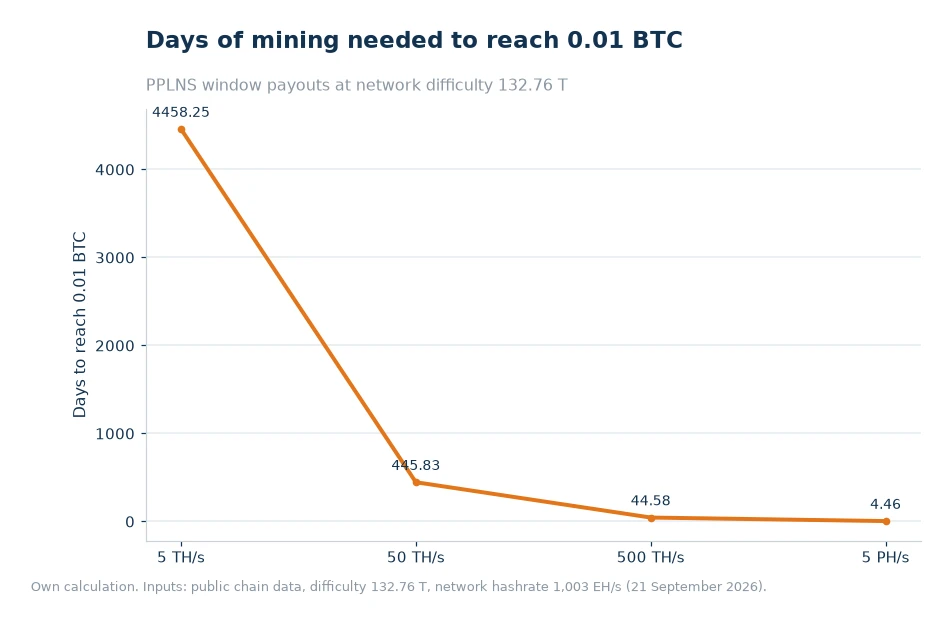
- Expected output scales linearly with hashrate: 5 TH/s needs about 4,458 days to earn 0.01 BTC, 500 TH/s needs about 45 days, and 5 PH/s about 4.5 days.
Context in 2026
Bitcoin produces 3.125 BTC per block and, at 144 blocks a day, 450 BTC across the network daily — around $38.1 million at $84,692 per coin. Network hashrate sits near 1,003 EH/s, which is the number that makes solo mining a curiosity and turns pool accounting into the real subject. When your proportional share of a pool's output is what determines income, the averaging window becomes the most important sentence in the terms of service.
Two payment modes dominate. PPS+ pays a theoretical reward for every valid share in the block-reward component, settled hourly against current difficulty, with a listed 4% fee, and routes the transaction-fee component through PPLNS logic at a listed 2%. PPLNS, the other mode, puts everything through the rolling window at a listed 2%. Both are priced off the same difficulty, so only the timing and the fee differ.
The two variables that matter
Variable one: the window
The window is measured in difficulty rounds, not minutes. Five rounds of 2,016 blocks each is about ten weeks of blocks if the network keeps to a ten-minute block time. Practically, that means your submitted shares keep earning for a long time after you stop submitting them, and equally that a large miner arriving mid-window dilutes your share of every block found until the old shares roll out. Neither effect is a fee; it is simple arithmetic on a moving denominator.
Variable two: confirmations
PPLNS credits appear only after a block the pool found receives six confirmations. In a quiet hour that is roughly an hour of waiting; on a bad day it is longer. Cash-flow planning therefore has to treat PPLNS income as arriving in lumps of unknown size at unknown times, which is the entire reason some miners accept the higher listed fee of PPS+ instead.
| Hashrate | BTC per day | USD per day | Days to 0.01 BTC | Days to 0.1 BTC |
|---|---|---|---|---|
| 5 TH/s | 0.00000224 | $0.19 | 4,458 | 44,583 |
| 50 TH/s | 0.0000224 | $1.90 | 446 | 4,458 |
| 500 TH/s | 0.000224 | $19.00 | 44.6 | 446 |
| 5 PH/s | 0.00224 | $189.97 | 4.5 | 44.6 |
Numbers from a real rig
Run the arithmetic on a single 500 TH/s unit on PPLNS. Gross expectation is 0.000224 BTC a day, or $19.00 at today's price. The first 0.001 BTC takes about 4.5 days of shares; the first 0.01 BTC takes roughly 45 days. The window matters here: those 45 days of shares are still partly live in the payout weight at the end, so if the machine goes offline on day 45 the miner keeps collecting a declining share of pool blocks for weeks afterwards — a genuine advantage over a system that pays strictly for work submitted today.
Reverse the same logic for a miner deciding whether to switch pools. If the machine has been running for months in pool A and moves to pool B, its weight in pool B starts from roughly zero and builds over the same window. The first weeks in the new pool look disappointing even when both pools have identical luck and fees. That is the single most misread PPLNS symptom: a switch that is correct on fees can look like a 10–20% income drop for a month purely because the window has to fill.
For a 5 PH/s setup the same maths gives 0.00224 BTC a day, about $189.97, with 0.01 BTC arriving every 4.5 days. Here the window's decay effect is worth real money, because a one-week outage still leaves a meaningful share of live weight paying out during the outage. The comparison is not PPLNS versus PPS+ in the abstract — it is the fee difference against the value of that decay.
Before running these numbers on your own hardware, replace my tiers with yours. An income calculator takes coin price, difficulty, the applicable fee rate and valid hashrate and returns estimated daily earnings, including merged-mining output, which most manual models forget. For a multi-rig operation, checking machine-level viability against a live miner profitability ranking is faster than rebuilding the spreadsheet each time difficulty adjusts.
Decision guide
- Fixed costs, thin margin. If electricity and hosting are due on a fixed calendar and the margin is a few dollars a day per rig, the hourly settlement of PPS+ is usually worth its listed 4% on the block-reward component, because the cash arrives when the invoice does.
- Room to absorb variance. If you can fund two months of power without selling coins, PPLNS at a listed 2% keeps more of the fee-derived income and lets the window work for you during outages.
- Recently switched pools. Give the new pool one full window of blocks before judging it. Anything shorter measures the window filling, not the pool.
- Small hashrate. At 5 TH/s the expectation is 0.00000224 BTC a day, so a payout threshold that is generous on paper can delay the first payout for months. Check the threshold before the mode.
- Multi-coin sites. A pool that supports BTC, BCH, LTC/DOGE merged mining, KAS and other chains lets you re-point a rig without changing operators — useful when a coin's profitability moves.[1]
Whichever mode you pick, the dashboard that matters is the one showing pool hashrate, network hashrate, difficulty and miner counts per coin, because those four series are what the window is computed from. The ViaBTC BTC Mining Pool state page publishes exactly those inputs, so a miner can recompute their own expected share instead of taking a summary figure on trust.
Frequently asked questions
How often should a miner check pool statistics?
Weekly is enough for cash flow, daily if you are reconciling worker uptime or chasing a hashrate fault.
Does the payout method change my average income?
It changes the variance and the fee, not the underlying expected value: your share of network hashrate still sets the ceiling.
What exactly is the PPLNS window measured in?
Difficulty rounds rather than hours — the last five rounds. At a ten-minute block time that is roughly ten weeks of blocks, which is why weight lingers after a rig stops mining.
Can PPLNS pay hourly?
No. Hourly settlement against current difficulty is a PPS+ behaviour; PPLNS distributions follow the blocks the pool finds and clear after six confirmations.
Write the window into your model
Add one line to your spreadsheet for mode and one for the window, then re-run the days-to-target maths whenever difficulty moves. Track pool hashrate weekly so you know whether your share of the pool is rising or being diluted, and treat the first month after any pool switch as a transition rather than evidence. Do that, and the PPLNS window stops being a surprise and becomes a term you priced in before you pointed the rigs.
Data and sources: ViaBTC fee and payment-mode documentation[1]. Network difficulty (132.76 T), network hashrate (1,003 EH/s) and the BTC price of $84,692 come from public chain data and market feeds read on 21 September 2026. Days-to-target figures are straight-line own calculations from those inputs and will change with difficulty.