Sourcing support can range from supplier discovery to quote comparison, quality coordination, logistics follow-up, and issue management. A clear scope states which tasks are included, what the buyer must decide or supply, how outputs will be delivered, and when extra work needs approval. This prevents broad service language from hiding gaps or creating expectations neither party has priced.
Key takeaways
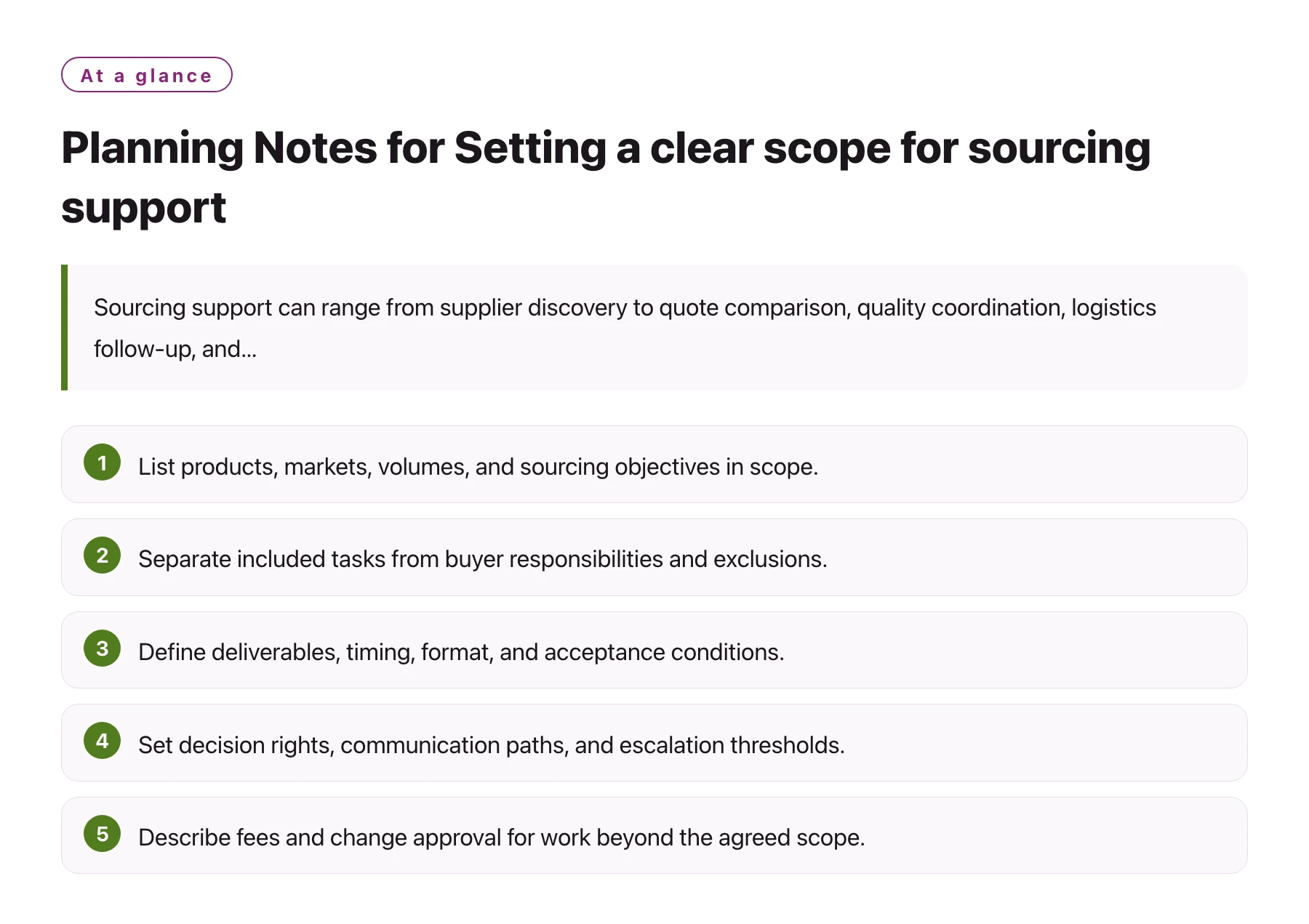
- List products, markets, volumes, and sourcing objectives in scope.
- Separate included tasks from buyer responsibilities and exclusions.
- Define deliverables, timing, format, and acceptance conditions.
- Set decision rights, communication paths, and escalation thresholds.
- Describe fees and change approval for work beyond the agreed scope.
Treat the scope as an operating agreement that links buyer needs to specific tasks, outputs, owners, and limits.
1. Describe products and intended markets
List product families, specifications, quantities, forecast range, destination markets, timeline, and known constraints. Identify whether work covers new product development, repeat orders, supplier replacement, or a one-time purchase. State excluded categories and markets.
Record market-specific documentation or technical review needs without assuming the sourcing provider determines regulatory classification. Name the buyer-side owner responsible for product requirements, intended use, and final compliance decisions.
2. Define the service tasks precisely
Specify whether the engagement includes supplier research, factory outreach, qualification, site visits, quote requests, negotiation support, sample coordination, order tracking, inspection booking, corrective-action follow-up, export documents, consolidation, or delivery updates. For each task, state the expected extent and frequency.
Avoid undefined phrases such as manage everything or end-to-end unless the supporting activities and boundaries are listed. A provider may coordinate a laboratory or forwarder without performing the technical test or transport service itself; state that distinction.
3. Assign buyer and provider responsibilities
Create a responsibility table for product specification, supplier selection, price approval, sample acceptance, compliance review, purchase order, payment, inspection criteria, concessions, shipment release, and receiving. Identify who prepares, reviews, approves, and is informed for each decision.
State which decisions require written buyer approval and which routine coordination steps the provider may complete independently. The provider should not commit funds, accept a deviation, or release goods unless the buyer has clearly delegated that authority.
4. Specify deliverables and acceptance
Describe each output: supplier shortlist, verification file, normalized quote matrix, sample log, meeting notes, production status, inspection report, corrective-action tracker, or shipment record. Set required fields, file format, language, due date, source documentation, and review period.
Define what makes an output complete and how the buyer requests correction. Distinguish information gathered from conclusions or recommendations. Where an output depends on supplier cooperation or buyer data, state the dependency and what happens if it is delayed.
5. Set supplier coverage and evidence standards
Define the number or type of suppliers to approach, target region, factory visibility, verification checks, and minimum evidence for inclusion. Clarify whether a supplier list is preliminary, screened, visited, audited, or qualified against a formal standard. Avoid implying that one check establishes every capability.
Ask how the provider documents sources, dates, contracting entities, production sites, subcontractors, capacity, and quality records. ISO 9001 describes quality management system requirements; a certificate claim should be checked for scope and site, and does not replace product-specific verification. [1]
6. Bound quality and compliance involvement
State whether the provider coordinates samples, inspection visits, laboratory tests, or document collection. Identify who sets acceptance criteria, interprets results, classifies the product, determines market requirements, and approves any concession. Third-party specialists may need separate contracts and fees.
List what quality activities are not included, such as continuous factory control, certification, regulatory representation, legal review, or product testing. If critical products need expert assessment, name the expertise required and the route for engaging it before order commitment.
7. Define communication, status, and escalation
Set meeting cadence, status template, response expectations, languages, time zones, contact roles, backup coverage, and urgent escalation channel. Define status terms such as open, at risk, blocked, pending buyer, supplier action, and closed so reports can be understood consistently.
Set thresholds for escalating quality failures, late milestones, changed prices, fraud concerns, unauthorized substitutions, or safety issues. Require an action log with owner and due date. Routine updates should not bury decisions that need executive, technical, or finance attention.
8. Clarify fees, expenses, and scope changes
List fixed fees, retainers, hourly rates, transaction fees, commissions, supplier visits, travel, translation, samples, inspection, testing, and third-party charges. State currency, tax treatment, payment timing, minimums, cancellation fees, and expense approval limits.
Describe how additional products, suppliers, markets, visits, or urgent work are estimated and approved. Do not treat a scope expansion as accepted based on an informal request. Record a change order with revised deliverables, fees, timing, and responsibilities.
9. Protect information and plan for exit
Specify confidentiality, permitted use, ownership, access, retention, and deletion for drawings, supplier lists, quotations, samples, photos, reports, and customer data. Clarify whether the buyer can communicate directly with suppliers and receive source documents.
Define handover at completion or termination: open orders, supplier contacts, current quote versions, approvals, inspection records, tooling status, and outstanding actions. Continuity depends on transferable records, not only access to a named coordinator.
10. Review the scope against actual work
Before signature, walk through a typical order and test whether every expected task has an owner, deliverable, time, and fee. Highlight exclusions and dependencies. Ask the provider to confirm the scope in a concise summary that can be checked during delivery.
Buyers engaging a China sourcing company can use a scope matrix to align supplier search, commercial decisions, quality coordination, and order follow-up. Review the matrix after a pilot or material business change and amend it before relying on support for new categories or markets.
Sources
Frequently asked questions
Why should sourcing support exclusions be written down?
Exclusions identify work the buyer must arrange and prevent assumptions about unpriced services or decision authority.
Can a provider approve every supplier and product decision?
Only when authority is explicitly delegated; the buyer should retain defined technical, commercial, and release approvals.
What belongs in a sourcing scope matrix?
Tasks, owner, deliverable, timing, acceptance, buyer input, fee, approval gate, and exclusions.
When should the support scope be revised?
Update it when products, markets, volume, services, responsibilities, or risk assumptions materially change.