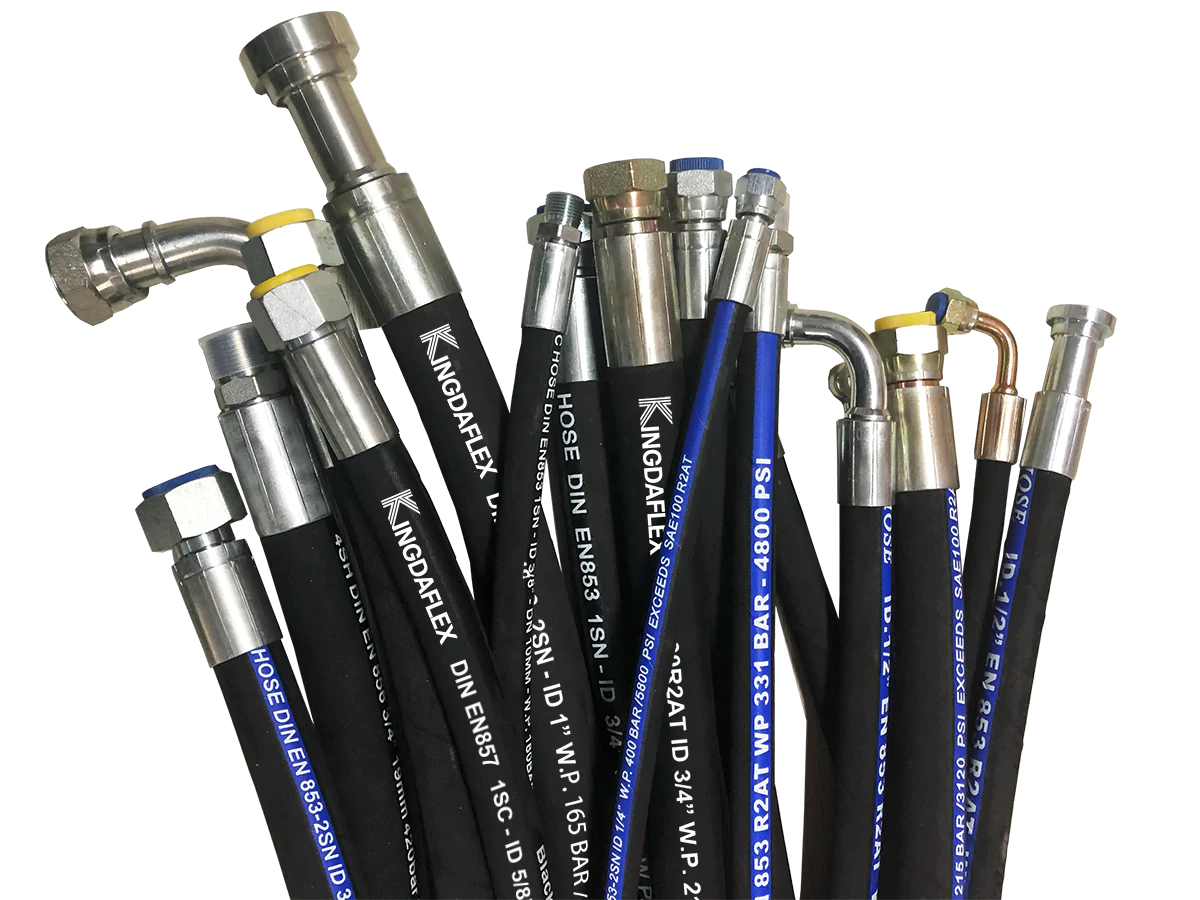
Choosing an industrial hose supplier for long-term growth requires more than comparing unit prices. A buyer should check working-pressure ratings, burst ratios, impulse performance, temperature limits, batch traceability, fitting compatibility, lead-time consistency, and corrective-action records. SAE J517 hydraulic hose families commonly use minimum burst-pressure ratios around 4:1, while ISO 18752 classifies hoses by pressure and impulse performance rather than construction alone. For a company buying 50,000 assemblies a year, even a 1% field-failure rate creates 500 replacements before labor, freight, machine downtime, or warranty administration is counted. Supplier selection should therefore measure repeatable production performance, not sample quality alone.
A supplier review should begin with the application data that controls hose life: fluid type, maximum continuous pressure, pressure peaks, temperature, bend radius, routing, environmental exposure, and coupling style. SAE J1273 gives guidance for hydraulic hose selection, routing, fabrication, installation, replacement, and maintenance, while ISO 12151 covers several hose-fitting connection types used in hydraulic systems. A hose rated to 3,000 psi may still be unsuitable when it operates close to the minimum bend radius, sees repeated pressure spikes, or carries fluid near the upper temperature limit.
Those operating conditions should then be converted into written purchasing specifications because verbal descriptions are difficult to control across repeat orders. A practical specification can state 12.7 mm nominal inside diameter, 21 MPa maximum working pressure, a defined temperature range, required reinforcement type, fitting material, assembly length tolerance, cleanliness requirement, proof-test level, marking method, packaging, and applicable standard revision. Even a 2% length variation can create installation problems in tightly routed equipment, so dimensional tolerances should be agreed before the first production lot.
A sample shows what a supplier can make once; three or more production batches show whether the supplier can make it repeatedly.
After the specification is fixed, manufacturing control becomes easier to evaluate. Hose production depends on compound preparation, tube extrusion, reinforcement placement, cover extrusion, curing, inspection, cutting, coupling preparation, crimping, and final testing. A buyer should ask which operations are performed in-house and which are subcontracted. If 30% of a finished assembly depends on outside processing, lead time and defect investigation can involve several companies rather than one accountable production system.
Production capacity also needs numbers rather than statements such as “large factory” or “fast delivery.” If current demand is 8,000 assemblies per month and the forecast is 12,000 within 18 months, ask for normal monthly output, peak output, machine utilization, shift structure, and reserved capacity. A supplier operating consistently above 90% of practical capacity has less room for urgent orders, maintenance shutdowns, or a sudden increase in demand than one with documented spare capacity and multiple qualified production lines.
The next review area is pressure testing because catalog ratings do not describe how every production batch behaves. Hydraulic hose standards commonly separate maximum working pressure, proof pressure, and minimum burst pressure. Many SAE hydraulic hose types use a burst-to-working-pressure ratio of about 4:1, although the applicable hose specification must always be checked. A 21 MPa working-pressure hose may therefore have a minimum burst requirement near 84 MPa under the relevant construction standard, but burst testing alone does not reproduce repeated service cycles.
Impulse testing adds that repeated-cycle information. ISO 18752 evaluates hydraulic hoses through pressure and impulse classes, and some hose categories are subjected to hundreds of thousands or more pressure cycles depending on the grade and test conditions. Buyers should request the standard number, hose size, test temperature, cycle count, test pressure, failure mode, and report date. A report from 2019 on a different diameter or construction offers less purchasing confidence than data connected to the current product and current production process.
Testing records become more useful when they connect back to traceability. Each shipment should be identifiable through production date, lot number, material batch, operator or line reference, inspection status, and assembly data where practical. If 10,000 assemblies are delivered and 14 units are reported with leakage, lot identification lets the quality team isolate the affected production period instead of questioning the entire shipment history. Traceability can reduce unnecessary replacement volume and shorten investigation time.
| Supplier record | What a buyer should request | Useful measurement |
|---|---|---|
| Incoming materials | Compound, wire, textile, fittings | Lot-level identification |
| Production | Date, line, process settings | Batch record |
| Crimping | Crimp diameter and tolerance | Measured per assembly plan |
| Pressure testing | Test pressure and result | Pass/fail by lot |
| Complaints | Failure mode and corrective work | PPM or % defect rate |
| Delivery | Promised vs. actual date | On-time delivery % |
Once traceability is established, fittings deserve equal attention because many assembly problems occur at the hose-to-coupling interface rather than in the hose body. A supplier should control stem geometry, ferrule dimensions, material grade, surface treatment, crimp diameter, insertion depth, and assembly equipment settings. A crimp diameter only 0.2-0.4 mm away from the approved range can matter on some constructions, so the buyer should obtain manufacturer-approved crimp specifications instead of allowing operators to work from memory.
Material compatibility follows from the same interface review. The inner tube must tolerate the conveyed fluid, while the cover may face ozone, UV exposure, oil, abrasion, road debris, seawater, or cleaning chemicals. Temperature can change compatibility substantially. A hose suitable for petroleum-based hydraulic fluid at 40°C should not automatically be approved for another fluid at 100°C. Suppliers should request fluid name, concentration where relevant, continuous temperature, short-duration peaks, and external environment before recommending a construction.
Purchasing teams comparing China hydraulic hose options or suppliers from any other sourcing market should apply the same documented qualification process: standard compliance, batch control, test capability, fitting compatibility, delivery history, and complaint response. Geography does not replace measurable manufacturing information. A buyer ordering 100,000 meters per year needs consistent dimensions and documented test performance across many batches, not a polished sample, factory photos, or a low opening quotation.
Commercial comparison should therefore move from piece price to annual cost. Assume Supplier A quotes an assembly at $18.40 and Supplier B at $19.10. On 40,000 units, Supplier A appears $28,000 cheaper. If Supplier A records a 1.5% replacement rate while Supplier B records 0.4%, the difference is 440 additional replacement units. At only $65 per replacement for product, labor, administration, and freight, those 440 units already add $28,600, before machine downtime is included.
Price differences are easy to see on a quotation; failure, inspection, freight, and downtime costs usually appear in different budgets.
Delivery performance should be measured with the same discipline. A supplier quoting 35 days but averaging 47 days creates a 12-day planning gap. If a plant consumes 600 assemblies per day, covering that gap can require 7,200 additional units of safety stock. At $20 per assembly, that is $144,000 tied up in inventory. On-time delivery percentage, average delay days, premium-freight frequency, and order-confirmation accuracy provide better information than the lead time printed on a quotation.
Forecast handling matters more as volume grows. A supplier receiving a 12-month forecast should explain which months require material reservations, when capacity becomes constrained, and how firm orders differ from forecast quantities. If monthly demand can vary by 25%, both companies need an agreed process for increases, reductions, and urgent orders. Buyers should also ask which raw materials have lead times above 60 or 90 days because those items often determine how quickly production can respond.
Quality complaints provide another view of supplier maturity. Request the number of complaints per million pieces, average response time, containment method, root-cause documentation, and closure time for corrective work. An 8D report is useful only when it identifies the actual failure mechanism and verifies corrective measures. Replacing a defective shipment without examining crimp settings, material lots, curing conditions, or inspection records leaves the production cause unchanged.
Supplier audits can verify whether written procedures are used on the production floor. During an audit, buyers can sample 5-10 recent production orders and compare material records, process sheets, inspection results, calibration status, and final shipment identification. They can also select several measuring devices and check whether calibration dates are current. ISO 9001 certification can support the assessment, but certification should not replace direct review of the processes that affect the purchased hose.
Engineering support becomes more important when new equipment is introduced. Ask how the supplier manages drawings, revisions, prototype builds, first-article inspection, material changes, and fitting updates. If a customer changes assembly length from 900 mm to 875 mm in 2026, the supplier should control the drawing revision so the old dimension cannot return during later production. Revision history matters especially when dozens or hundreds of hose assembly part numbers are active.
A growing buyer should also review supply continuity. Ask whether major rubber compounds, steel wire, textile reinforcement, and fittings have qualified alternative sources. An alternative source should not be substituted without validation when it can affect pressure performance or compatibility. For high-volume programs, buyers may request 30-60 days of agreed material coverage or maintain a second approved supplier for selected part numbers, depending on demand stability and transport time.
The relationship can then be measured through a supplier scorecard rather than informal impressions. A workable model might assign 30% to product quality, 20% to technical capability, 15% to delivery, 15% to total cost, 10% to capacity, and 10% to service and corrective response. A supplier scoring 92/100 with stable delivery and low complaint rates can be compared consistently with one scoring 78/100 despite a lower quoted price.
Before moving full annual volume, use staged qualification. A buyer might approve laboratory samples first, then place a 500-unit pilot order, followed by three production lots of 2,000-5,000 units each. Dimensions, proof-test results, packaging, labeling, delivery accuracy, fitting performance, and complaint data can be reviewed after every lot. Moving from samples to repeated production lots gives purchasing, engineering, and quality teams a much stronger basis for awarding a multi-year supply program.