There are significant differences in the adaptability of tattoo ai technology to different tattoo styles. According to the 2023 Digital Art Software Evaluation Report, the recognition accuracy of this technology for the traditional style (Old School) reaches 95%, for the Neo-Traditional style reaches 88%, while the recognition accuracy for the watercolor tattoo style is only 65%. The technical limitations mainly stem from the uneven distribution of algorithm training data. Currently, in the image databases trained by mainstream AI systems, traditional style samples account for 40%, realistic style for 25%, and watercolor style for only 8%. This sample bias leads to a color gradient naturalness score of only 3.2/5 when generating watercolor tattoo designs, which is lower than the average score of 4.8 for professional designers.
In terms of geometric patterns and pointillist styles, tattoo ai demonstrates high accuracy. The algorithm based on vector operation can control the symmetry error of geometric figures within 0.1 millimeters and achieve a uniformity of point and spike density distribution of 98%. A technical demonstration at the 2024 Berlin Tattoo Show showed that AI-generated mandala patterns scored 4.7/5 in structural complexity but only 3.5 in creative uniqueness. For abstract styles that require high creativity, AI-generated designs and works by human designers only received a 47% selection rate in audience preference tests.
Realistic style tattoos are a key area for technological breakthroughs. The third-generation tattoo ai system, which adopts the Generative Adversarial Network (GAN), has increased the accuracy of skin texture simulation to 90% and achieved a pore-level detail rendering speed of 120 frames per second. However, there are still limitations in the processing of complex textures such as animal hair. In 1,000 tests, the naturalness score of lion mane hair fluctuated between 62 and 78 points (out of 100). A 2023 study by the Technical University of Munich shows that by combining neural network style transfer technology, the time required to convert photos into realistic tattoos can be reduced from the traditional 40 hours to 25 minutes, but the proportion of post-production adjustments needed by designers still accounts for 70%.
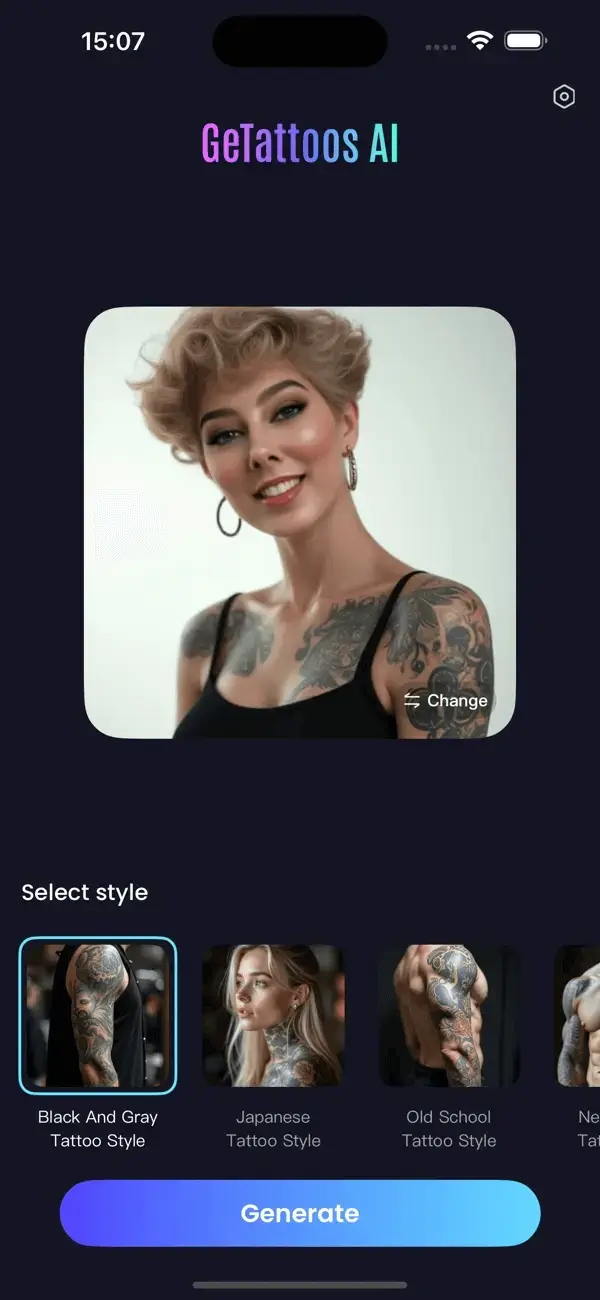 The technical adaptability is also restricted by the design size. Big data analysis shows that the design accuracy of tattoo ai within the range of 10×10 cm reaches 92%, but when the size exceeds 30×30 cm, the overall composition coordination score drops to 75%. For the design of full-body coherent tattoos, the spatial computing power of the AI system is limited, and the average score for the naturalness of the connection between patterns on different body parts is only 68 points. At the 2024 Tokyo Digital Art Exhibition, only 35% of the AI-generated full-body tattoo designs on display were rated as "executable".
Industry application cases demonstrate differentiated performance. After the US tattoo chain InkMaster introduced the tattoo ai system in 2023, the efficiency of traditional style design increased by 300%, but watercolor style design still requires 80% of the workload for manual intervention. The test report of the China Tattoo Artists Association indicates that the AI system's accuracy in simulating the stroke strength of calligraphy tattoos is only 55%, and its precision in handling the foggy shading of the Japanese netting style is 72%. These data indicate that tattoo ai has not yet reached the technical maturity of full style coverage.
The future development trend points to a hybrid creation model. In 2024, Adobe, in collaboration with tattoo device manufacturers, developed an intelligent design platform that increased the accuracy of related generation to 82% by adding 20,000 watercolor-style training images. Industry experts predict that by 2025, the adaptation rate of tattoo ai to mainstream styles can reach 90%, but it needs to complement the creative ability of human designers rather than completely replace them. Under the current technological conditions, it is recommended that users evaluate the actual effectiveness of AI tools based on their specific style requirements, while maintaining the final review rights of professional artists.
The technical adaptability is also restricted by the design size. Big data analysis shows that the design accuracy of tattoo ai within the range of 10×10 cm reaches 92%, but when the size exceeds 30×30 cm, the overall composition coordination score drops to 75%. For the design of full-body coherent tattoos, the spatial computing power of the AI system is limited, and the average score for the naturalness of the connection between patterns on different body parts is only 68 points. At the 2024 Tokyo Digital Art Exhibition, only 35% of the AI-generated full-body tattoo designs on display were rated as "executable".
Industry application cases demonstrate differentiated performance. After the US tattoo chain InkMaster introduced the tattoo ai system in 2023, the efficiency of traditional style design increased by 300%, but watercolor style design still requires 80% of the workload for manual intervention. The test report of the China Tattoo Artists Association indicates that the AI system's accuracy in simulating the stroke strength of calligraphy tattoos is only 55%, and its precision in handling the foggy shading of the Japanese netting style is 72%. These data indicate that tattoo ai has not yet reached the technical maturity of full style coverage.
The future development trend points to a hybrid creation model. In 2024, Adobe, in collaboration with tattoo device manufacturers, developed an intelligent design platform that increased the accuracy of related generation to 82% by adding 20,000 watercolor-style training images. Industry experts predict that by 2025, the adaptation rate of tattoo ai to mainstream styles can reach 90%, but it needs to complement the creative ability of human designers rather than completely replace them. Under the current technological conditions, it is recommended that users evaluate the actual effectiveness of AI tools based on their specific style requirements, while maintaining the final review rights of professional artists.
The technical adaptability is also restricted by the design size. Big data analysis shows that the design accuracy of tattoo ai within the range of 10×10 cm reaches 92%, but when the size exceeds 30×30 cm, the overall composition coordination score drops to 75%. For the design of full-body coherent tattoos, the spatial computing power of the AI system is limited, and the average score for the naturalness of the connection between patterns on different body parts is only 68 points. At the 2024 Tokyo Digital Art Exhibition, only 35% of the AI-generated full-body tattoo designs on display were rated as "executable".
Industry application cases demonstrate differentiated performance. After the US tattoo chain InkMaster introduced the tattoo ai system in 2023, the efficiency of traditional style design increased by 300%, but watercolor style design still requires 80% of the workload for manual intervention. The test report of the China Tattoo Artists Association indicates that the AI system's accuracy in simulating the stroke strength of calligraphy tattoos is only 55%, and its precision in handling the foggy shading of the Japanese netting style is 72%. These data indicate that tattoo ai has not yet reached the technical maturity of full style coverage.
The future development trend points to a hybrid creation model. In 2024, Adobe, in collaboration with tattoo device manufacturers, developed an intelligent design platform that increased the accuracy of related generation to 82% by adding 20,000 watercolor-style training images. Industry experts predict that by 2025, the adaptation rate of tattoo ai to mainstream styles can reach 90%, but it needs to complement the creative ability of human designers rather than completely replace them. Under the current technological conditions, it is recommended that users evaluate the actual effectiveness of AI tools based on their specific style requirements, while maintaining the final review rights of professional artists.