The way brands choose a perfume factory has changed more in the last few years than in the previous decade. Price per unit is still on the table, but it is no longer the first question. Buyers now open with documentation, packaging constraints and capacity planning, because those are the things that decide whether a launch happens on time. A supplier still answering only the price question is telling you something about how it works.
Key takeaways
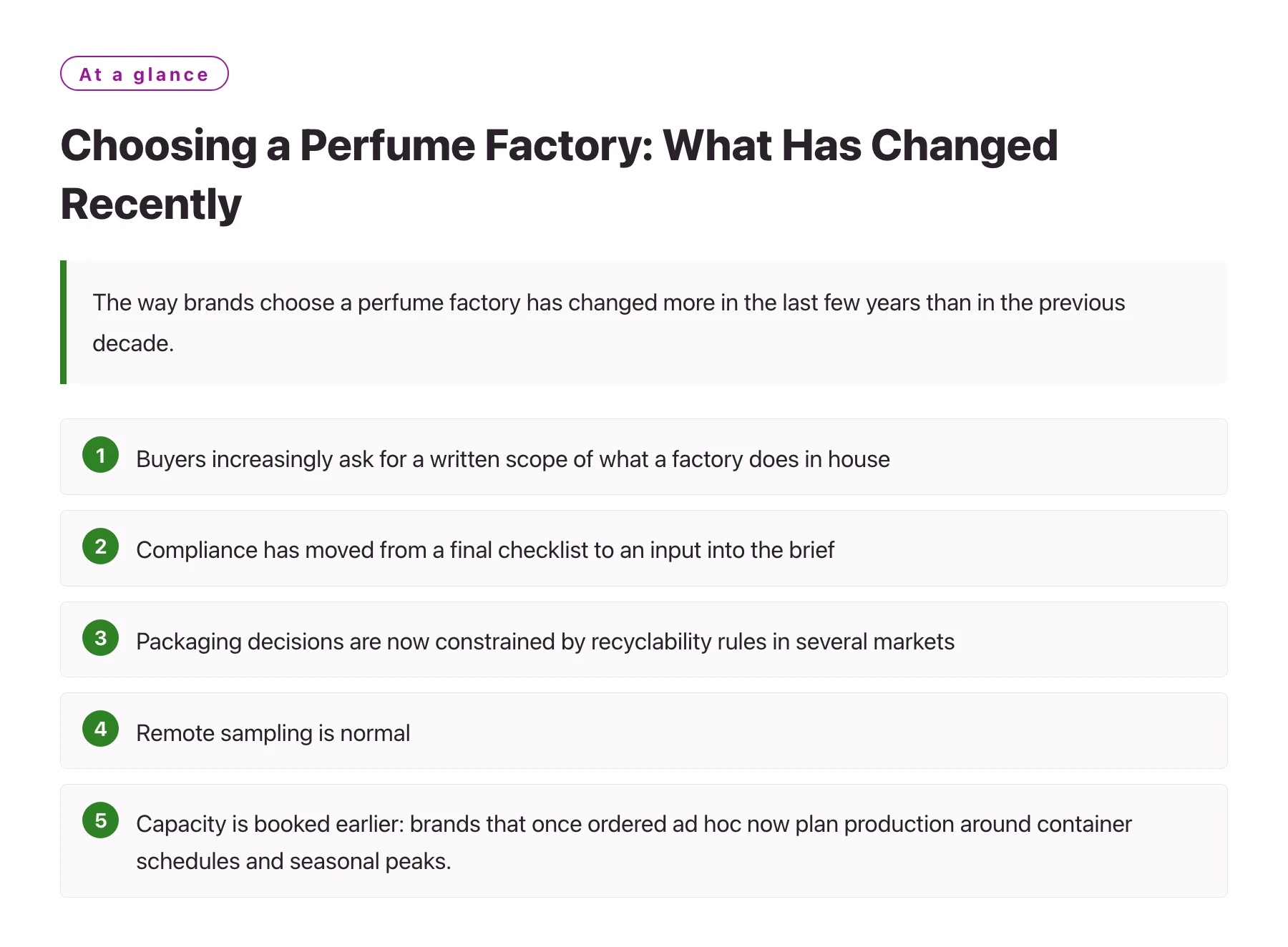
- Buyers increasingly ask for a written scope of what a factory does in house, because subcontracted steps change both lead time and accountability.
- Compliance has moved from a final checklist to an input into the brief, since labelling and documentation requirements differ by market [1].
- Packaging decisions are now constrained by recyclability rules in several markets, so material choice is discussed at the concept stage rather than after launch [2].
- Remote sampling is normal, but a retained physical reference held by both parties is still what settles disputes.
- Capacity is booked earlier: brands that once ordered ad hoc now plan production around container schedules and seasonal peaks.
Ten years ago, choosing a factory was mostly a negotiation about price and minimum order quantity. A buyer sent a brief, received a quotation, negotiated, and ordered. The supplier's compliance paperwork mattered mainly at the destination port.
Today the same buyer arrives with a longer list. Part of that is regulation, part is the growth of small brands that cannot absorb a failed launch, and part is simple experience: brands have learned which questions, asked late, cost the most money.
The table below sets out what changed, and the sections after it explain how to use each shift when you are screening suppliers.
Then and now
| Question | What buyers asked a few years ago | What they ask now |
|---|---|---|
| Price | What is the unit cost | What is included in the unit cost, and what is billed separately |
| Scope | Can you make this | Which steps are done in house and which are subcontracted |
| Compliance | Can you provide documents | Which market requirements are covered, and by whom |
| Packaging | Can you match this bottle | What material and format will meet the recyclability rules we sell under |
| Sampling | Send three samples | How do we approve a reference and retain it |
| Capacity | What is your lead time | When can you book our volume, and what happens in peak season |
| Verification | Send your certificate | What is the certificate number, scope and issuing body |
| Communication | Who is our contact | Who owns the project file and how are changes logged |
The last row is the one that changed most quietly. A single named contact who owns a project file is now treated as part of the product, because launches fail on lost information more often than on machinery. It is worth asking how a supplier describes its own history and limits as well, since the facts set out under its background and certifications are easier to verify than a capability claim.
Why documentation moved to the front of the conversation
Regulation did not suddenly appear; the difference is who is expected to hold the paperwork. Brands selling across borders now plan the documents at the same time as the product, because the label, the safety assessment and the ingredient declaration all feed into each other. Industry bodies publish guidance that reflects how those obligations are organised in practice [1], and a supplier that exports regularly usually has a document pack ready for its main markets.
The practical test is simple: ask which documents arrive automatically with a first order and which have to be requested. Anything in the second group should be priced and scheduled before the order is placed. It also helps to know which steps sit with the same team, because a factory that handles a factory that handles fragrance R&D and production can answer document questions about development and filling in one pass.
Packaging became a design constraint
A few years ago a premium pack was limited mainly by cost and tooling. Now recyclability and material rules in several markets shape what can be sold at all, and design guidance from packaging bodies is increasingly specific about what counts as recyclable in practice [2]. A factory that cannot discuss material choice at the sketch stage will hand you a design problem after launch.
Remote work moved the approval step, not the standard
Video tours and couriered samples replaced a lot of travel, and most projects now run without a factory visit. What did not change is that approval needs a physical reference. A sealed sample with a date and a batch code, held by both sides, is still the only reliable defence when a later batch smells different.
How to use these shifts when screening suppliers
Start with scope. A written list of which operations are performed on site, from compounding to filling and decoration, tells you where the risk sits and makes two quotations comparable. Ask for that list in writing and note which steps are subcontracted.
Then look at the record. Certificates describe a management system; batch records describe a specific run. Ask to walk through one record from raw material intake to release, and ask what triggered a rejected batch in the last year. The answer is more informative than the certificate.
If you want a structured version of this screen, the questions worth asking before a deposit are collected in this guide to how to choose a perfume factory; the point of reading it is to arrive at the first meeting with a checklist rather than a hunch.
Ask about capacity in the season you need
A lead time quoted in a quiet month is not a lead time. Ask when the factory's peak period falls, how it allocates lines, and what notice it needs to reserve volume. Brands that plan around container schedules rather than around hope get fewer unpleasant surprises.
Ask who owns the project file
Request the name of the person accountable for your project and the mechanism for logging changes to the formula, the pack or the artwork. A supplier that cannot answer this has not yet thought about how your order will be handed between departments.
None of these changes makes choosing a factory harder; they make it harder to choose badly. The suppliers who were always careful now look better on paper, because the questions finally match the way they work.
Sources
- Cosmetics Europe —— The European trade association for the cosmetics and personal care industry, publishing guidance, positions and market information.
- Sustainable Packaging Coalition —— A membership organisation working on more sustainable packaging design, publishing material and recyclability guidance.
Frequently asked questions
Do I need to visit a perfume factory before ordering?
Not necessarily. Many projects run remotely with video walkthroughs and couriered samples. If you do not visit, compensate by asking for batch records and by holding a retained reference sample.
What is the first document I should request?
A written scope of operations, stating what is done in house and what is subcontracted. It frames every other question, from lead time to who is accountable when something goes wrong.
Has the minimum order quantity changed?
In practice, yes, for brands using stock components and library directions. Custom tooling still imposes a floor, because mould and print setup costs have to be absorbed by the order.
How do I verify a certificate?
Ask for the certificate number, the issuing body and the scope, then check with the issuing body directly. Treat the certificate as the start of a conversation rather than the end of one.
Why does recyclability come up before the design is finished?
Because material and format choices determine whether a pack can be recycled at all. Changing those after tooling is expensive, and in some markets it affects whether the product can be sold as described.