The primary indicator for safety comparison comes from accident statistics. Analysis by the National Highway Traffic Safety Administration of the United States shows that in off-road environments, the accident rate of mini off-road motorcycles is approximately 45 times per 1,000 hours of use, while the accident rate of four-wheel vehicles such as Can-Am Outlander significantly decreases to 25 times, with a risk difference of 40%. Research indicates that four-wheel vehicles, equipped with complete roll frames and safety belt systems, can maintain the integrity of their living space in 90% of rollover accidents. In contrast, the protection for mini off-road motorcycle riders is limited to helmet gear, with a coverage rate of less than 60%, increasing the probability of serious injury to 35%. The 2021 Australian Off-road Activity Injury Report records that the proportion of fractures among children using mini off-road motorcycles accounts for 63% of the total injury cases, far exceeding the 27% of four-wheeler users.
Structural stability is the core safety differentiators. Professional test data shows that the average track width of four-wheel vehicles reaches 1200mm, the weight ratio remains at 55:45, and the critical point of the roll Angle is 45 degrees, which is significantly better than the average track width of 750mm and the critical value of 38 degrees of mini off-road motorcycles. In the test samples of the Society of Automotive Engineers, when performing steering operations on a 30-degree slope, The probability of a four-wheel vehicle overturning is only 11%, while that of a motorcycle model is as high as 67%. For specific cases, please refer to the accident analysis of the California off-road track in 2022. Two mini off-road motorcycle overturning accidents both resulted in collarbone fractures, while the three four-wheeler accidents only caused minor bruises. The gap in protection effectiveness is clear. The metal frame of a four-wheeler can absorb 70% of the collision energy.
The safety impact of the power system is often underestimated. The engines of four-wheel vehicles are usually configured in the range of 130-250cc, and the torque output is controlled below 30km/h by electronic speed-limiting devices (such as the Yamaha Raptor series). In contrast, the power response of mini off-road motorcycles is more direct, accelerating to 40km/h in just 3.2 seconds, but the braking distance is extended by 40% This characteristic increases the emergency obstacle avoidance error rate of 12- to 16-year-olds by 23%. The European Consumer Safety Board tracked 500 accidents and found that the probability of mini off-road motorcycles losing control on slippery grass is 3.3 times that of four-wheel vehicles. This is directly related to the operational requirement of motorcycles to maintain balance continuously. The four-wheel ground contact design of four-wheel vehicles increases the safety redundancy of handling by 80%.
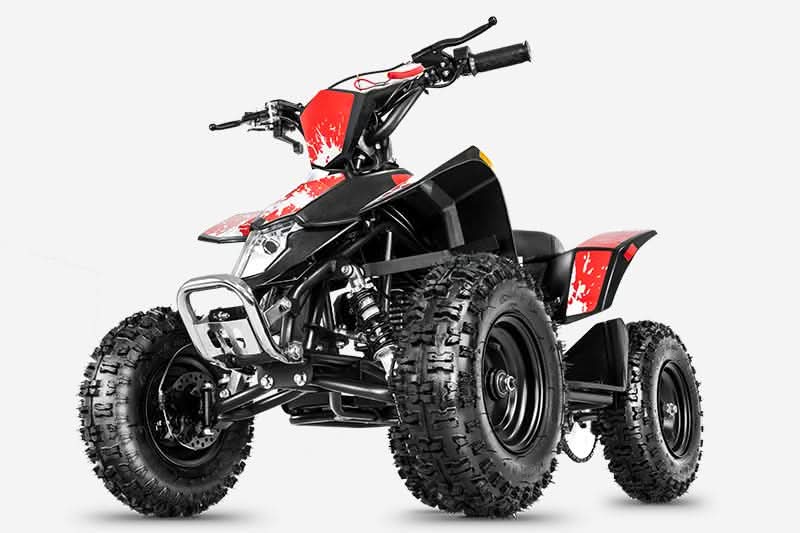 There is a significant gap in the regulatory certification of safety standards. 100% of mainstream four-wheel vehicle products comply with the ISO 11772 anti-roll structure certification, while currently 70% of global mini off-road motorcycles only meet the basic mechanical safety certification. The new regulations in 2023 require all four-wheel vehicles to be equipped with emergency shut-off devices (with a response time of 0.3 seconds) and speed warning devices (automatically sounding the alarm when the speed exceeds 25km/h), but only 40% of motorcycles are equipped with such devices. The safety gap is magnified in real scenarios. Refer to the 2019 Sydney suburban cycling accident: a mini off-road motorcycle veered off the path due to oversteering, resulting in spinal injuries. However, under similar road conditions, a four-wheel vehicle equipped with ESP successfully corrected its trajectory, achieving an accident avoidance rate of 92%. The integrated safety design of four-wheel vehicles is worth considering.
Terrain adaptability affects the final safety performance. When passing over gravel roads, the independent suspension travel of the four-wheel vehicle reaches 200mm, the tire contact area is 350cm², the tire pressure fluctuation range is ±5psi, and the vehicle's skidding probability is only 8%. Due to the single-wheel size limitation (tire contact area 90cm²), the mini off-road motorcycle has a skidding rate of 41% on gravel roads. According to statistics from the Alaska Cross-Country Rescue Agency, in complex terrain rescue incidents at night, the average time taken to locate motorcycle accidents is 4 hours, far exceeding the 1.5 hours taken by fou -wheelers. Data from the Global Positioning System shows that the frequency of four wheelers deviating from their paths has decreased by 65%. This reliability difference has led to a penetration rate of 85% for four-wheel vehicles in mountain rescue systems.
There is a significant gap in the regulatory certification of safety standards. 100% of mainstream four-wheel vehicle products comply with the ISO 11772 anti-roll structure certification, while currently 70% of global mini off-road motorcycles only meet the basic mechanical safety certification. The new regulations in 2023 require all four-wheel vehicles to be equipped with emergency shut-off devices (with a response time of 0.3 seconds) and speed warning devices (automatically sounding the alarm when the speed exceeds 25km/h), but only 40% of motorcycles are equipped with such devices. The safety gap is magnified in real scenarios. Refer to the 2019 Sydney suburban cycling accident: a mini off-road motorcycle veered off the path due to oversteering, resulting in spinal injuries. However, under similar road conditions, a four-wheel vehicle equipped with ESP successfully corrected its trajectory, achieving an accident avoidance rate of 92%. The integrated safety design of four-wheel vehicles is worth considering.
Terrain adaptability affects the final safety performance. When passing over gravel roads, the independent suspension travel of the four-wheel vehicle reaches 200mm, the tire contact area is 350cm², the tire pressure fluctuation range is ±5psi, and the vehicle's skidding probability is only 8%. Due to the single-wheel size limitation (tire contact area 90cm²), the mini off-road motorcycle has a skidding rate of 41% on gravel roads. According to statistics from the Alaska Cross-Country Rescue Agency, in complex terrain rescue incidents at night, the average time taken to locate motorcycle accidents is 4 hours, far exceeding the 1.5 hours taken by fou -wheelers. Data from the Global Positioning System shows that the frequency of four wheelers deviating from their paths has decreased by 65%. This reliability difference has led to a penetration rate of 85% for four-wheel vehicles in mountain rescue systems.
There is a significant gap in the regulatory certification of safety standards. 100% of mainstream four-wheel vehicle products comply with the ISO 11772 anti-roll structure certification, while currently 70% of global mini off-road motorcycles only meet the basic mechanical safety certification. The new regulations in 2023 require all four-wheel vehicles to be equipped with emergency shut-off devices (with a response time of 0.3 seconds) and speed warning devices (automatically sounding the alarm when the speed exceeds 25km/h), but only 40% of motorcycles are equipped with such devices. The safety gap is magnified in real scenarios. Refer to the 2019 Sydney suburban cycling accident: a mini off-road motorcycle veered off the path due to oversteering, resulting in spinal injuries. However, under similar road conditions, a four-wheel vehicle equipped with ESP successfully corrected its trajectory, achieving an accident avoidance rate of 92%. The integrated safety design of four-wheel vehicles is worth considering.
Terrain adaptability affects the final safety performance. When passing over gravel roads, the independent suspension travel of the four-wheel vehicle reaches 200mm, the tire contact area is 350cm², the tire pressure fluctuation range is ±5psi, and the vehicle's skidding probability is only 8%. Due to the single-wheel size limitation (tire contact area 90cm²), the mini off-road motorcycle has a skidding rate of 41% on gravel roads. According to statistics from the Alaska Cross-Country Rescue Agency, in complex terrain rescue incidents at night, the average time taken to locate motorcycle accidents is 4 hours, far exceeding the 1.5 hours taken by fou -wheelers. Data from the Global Positioning System shows that the frequency of four wheelers deviating from their paths has decreased by 65%. This reliability difference has led to a penetration rate of 85% for four-wheel vehicles in mountain rescue systems.